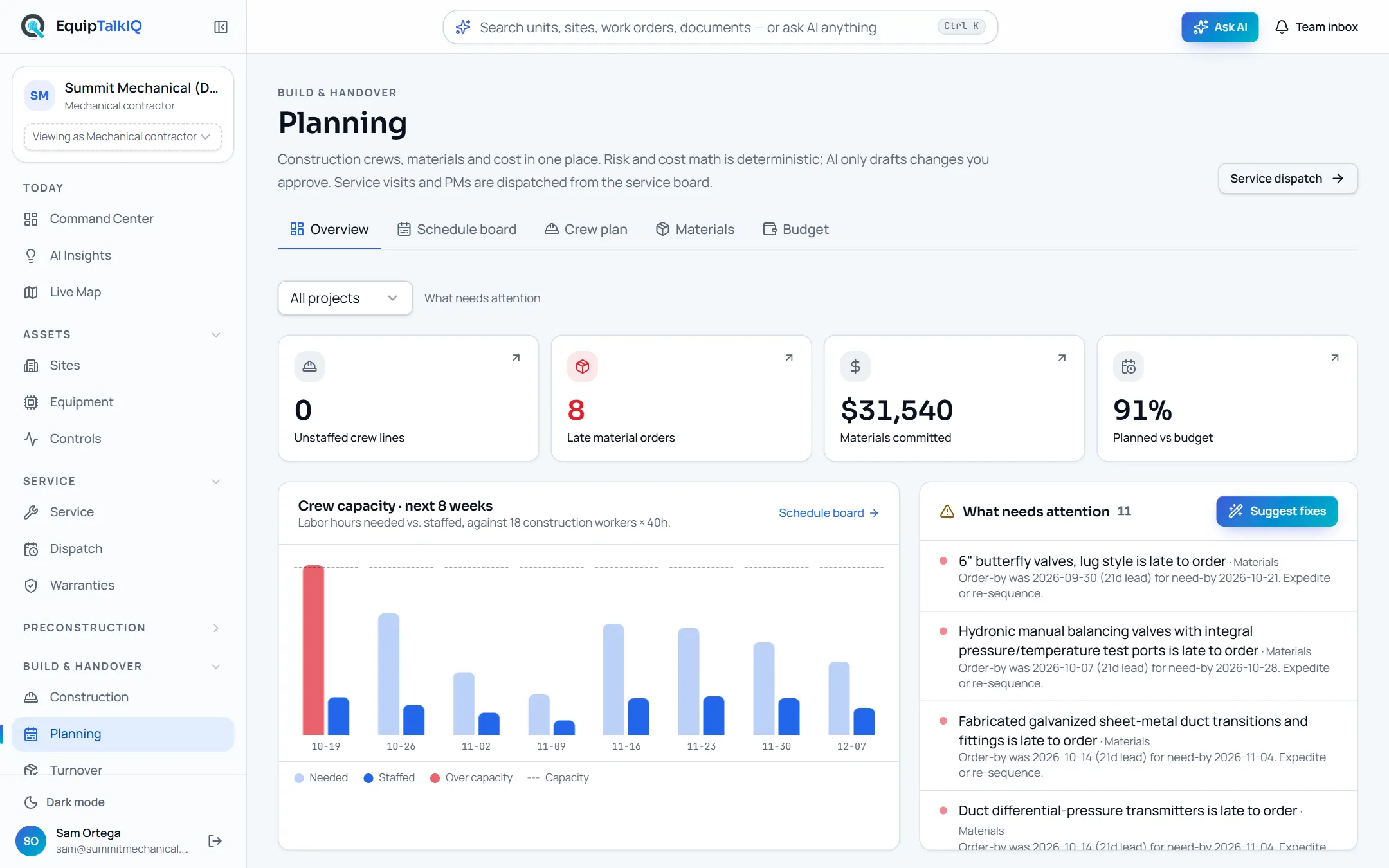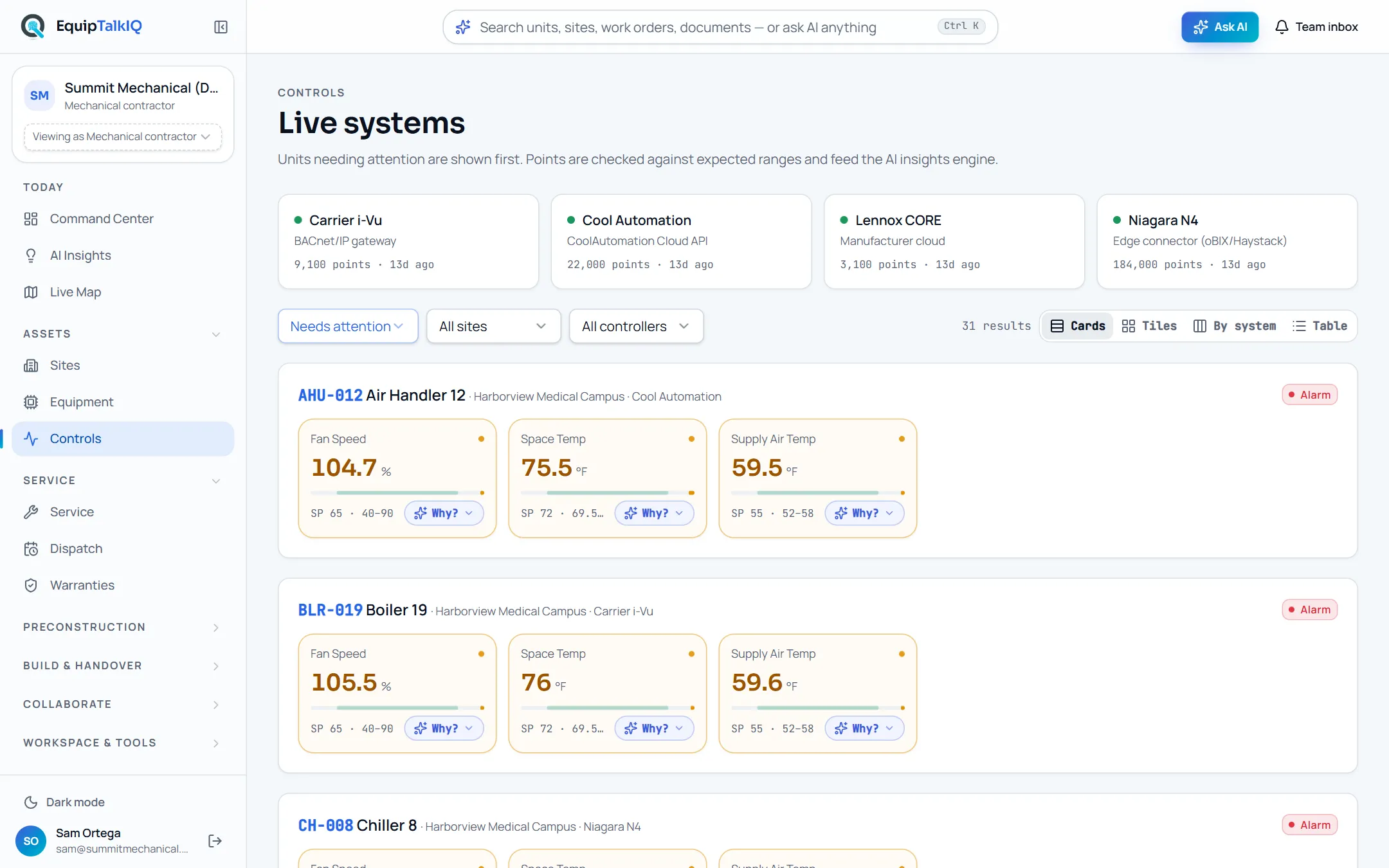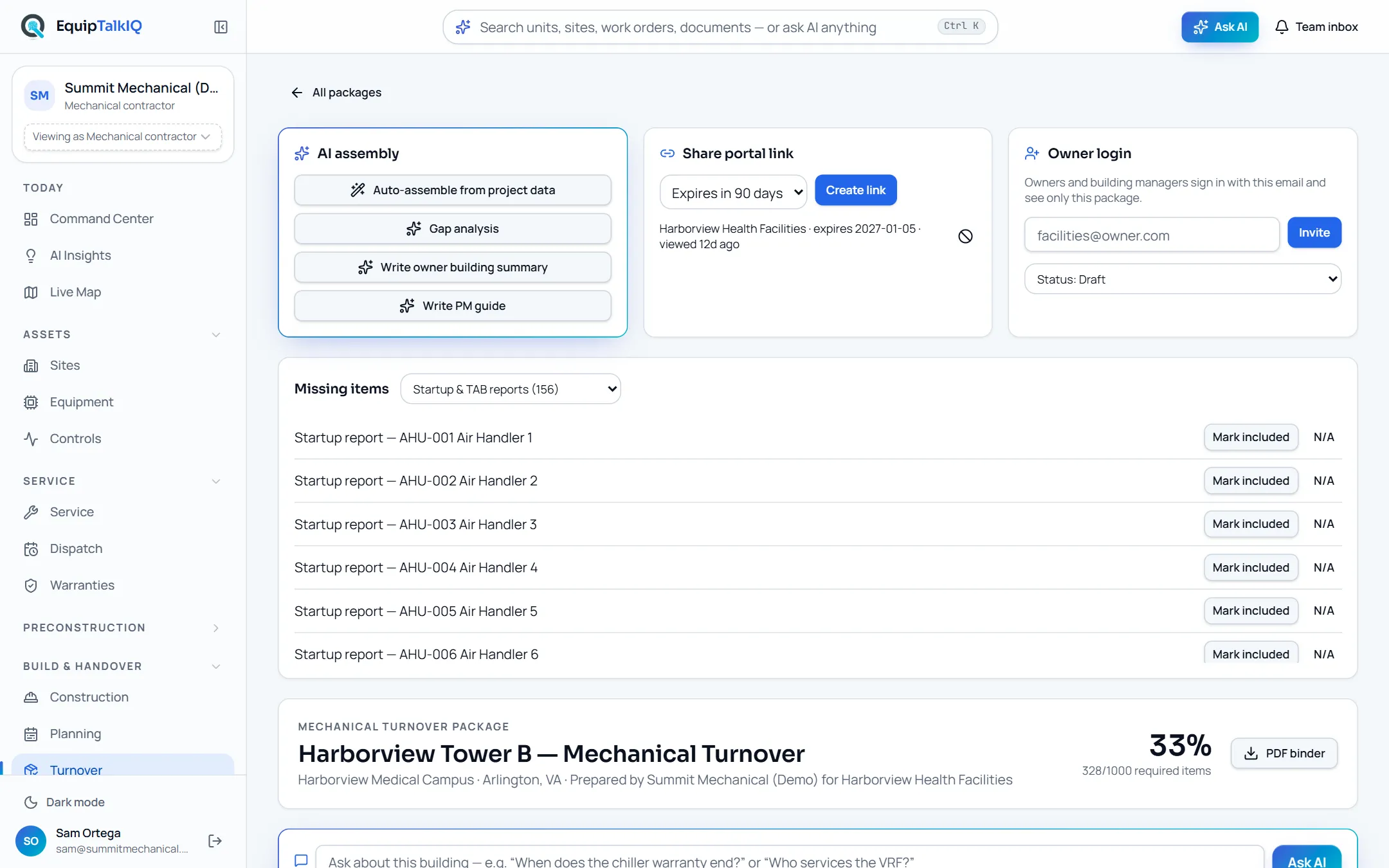
The asset is connected. Its information often isn’t.
An air-handling unit does not belong to just one department. Estimating knows its scheduled capacity. Construction knows the approved selection and installation conditions. Service knows what was replaced during the last visit. Controls knows what the sensors are reporting. The building owner knows which spaces are affected when it stops working.
Yet those pieces can live in different systems, with different naming conventions and different people responsible for them. Searching for AHU-01 may find a manual without the latest service visit—or an alarm without the agreement that determines the scope of preventive maintenance. A useful equipment conversation needs the relationship between the records, not just a folder with everything in it.
Context changes the next question.
Suppose a supply-air temperature appears unusual. A point by itself does not establish a failed component. Operating mode, setpoint, sensor condition, occupancy, weather, and recent work can all change its meaning. Adding a service note does not magically produce a diagnosis either. It makes the investigation more specific.
In EquipTalkIQ, equipment and site conversations are scoped to the selected asset or location. The assistant can retrieve relevant records rather than treating every document in the company as equally relevant. The public example below uses fixed sample information. Its purpose is to make that difference visible, not to simulate a live control system.
- Confirm the operating state before interpreting a point.
- Check recent work and the applicable service agreement.
- Use the manual to frame field checks, not to invent a diagnosis.
A unit. Its entire story.
Sample records and answers. Your saved conversations use your site and equipment context.
A bigger picture should not mean broader access.
A contractor, manufacturer rep, general contractor, and owner may all discuss the same equipment. They do not need the same commercial information. An owner’s equipment view should not include a contractor’s internal labor costs. A general contractor’s coordination view should not inherit a rep’s commissions or internal notes.
That separation must also apply to the information supplied to AI. A different-looking screen is not a security boundary. EquipTalkIQ uses account-specific access and separate AI entry points so each audience reasons from the information available to that audience. Shared snapshots provide intentional collaboration without granting company-wide access.
Keep the human decision in the loop.
Good assistance makes its limits visible. A missing service record is not evidence that maintenance never happened. A manual may describe a product family rather than the installed configuration. Simulated telemetry cannot establish what a real sensor is doing. Those distinctions belong in the answer, not in fine print after the decision.
The practical outcome is a more focused service visit: relevant records together, questions preserved, and findings attached to the asset for the next person. The technician still checks the equipment. The service manager still approves the scope. AI helps the knowledge travel.
The best next question is often more valuable than a confident diagnosis.
See the EquipTalkIQ platform